Grasp, move and coordinate on cycle time
Getting a grip on real parts, moving without collisions, and keeping two arms out of each other’s way, within the speed and force limits a shared workspace needs.
- Maximum grip force of a Robotiq 2F-85. Most failures to hold a light part are friction or geometry, not force.
- 235 NMaximum grip force of a Robotiq 2F-85. Most failures to hold a light part are friction or geometry, not force.
- The licence of KDL, MoveIt’s default inverse-kinematics plugin. Almost nobody notices; we check.
- LGPL-2.1The licence of KDL, MoveIt’s default inverse-kinematics plugin. Almost nobody notices; we check.
- Speed-and-separation and power-and-force limits we design to when people and arms share a space.
- ISO/TS 15066Speed-and-separation and power-and-force limits we design to when people and arms share a space.
What we do
Grasping solutions
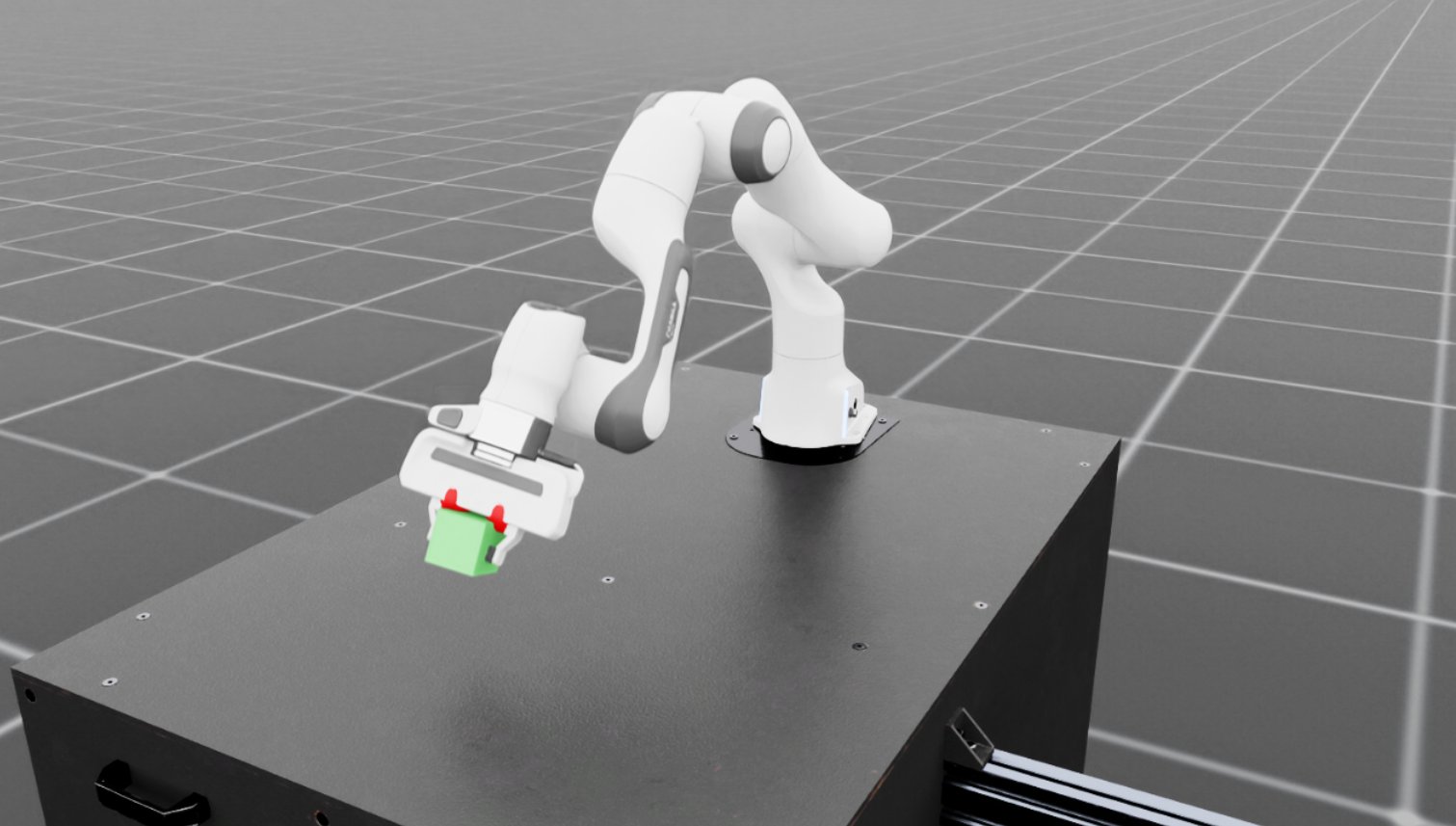
Reliable grasps on the parts you actually have, including dense and messy bins.
- Parallel-jaw, suction and multi-finger grippers
- Grasp planning in dense, cluttered bins
- Pushing and singulation before the grasp
- Collision and reachability checks on every grasp
Motion planning and arm control
Collision-free paths and controllers that handle contact.
- MoveIt 2 with OMPL and Pilz planners
- GPU motion generation with cuRobo
- Time-optimal trajectories with Ruckig and TOPP-RA
- Force, impedance and compliance control
Multi-arm movement and coordination
Two or more arms sharing a workspace safely.
- Shared-workspace collision avoidance
- Synchronized trajectories and handovers
- Bimanual policies for two-handed tasks
Model or no model
Where should the gripper close, and how does the arm get there?
Programmed approach
- Grasps precomputed from CAD or simple shapes
- MoveIt 2 planners and inverse kinematics
- Trajectory optimization for cycle time
Learned approach
- Grasp proposals predicted from point clouds
- Learned grasp-success scoring
- Policies for contact-rich final motions
How we choose
Known parts in known poses get precomputed grasps, and free-space moves stay programmed because they are fast and verifiable. Mixed objects in dense bins get learned grasp proposals, each filtered by collision and reachability checks before the arm moves.
Grasp models and their catches
A grasp model is trained for a particular gripper, and its licence decides whether you can ship it.
| Model | Gripper it assumes | Catch |
|---|---|---|
| Contact-GraspNet | Franka hand | Re-check grasps for your jaw width |
| GraspGen | Gripper given as an input | Needs a GPU |
| AnyGrasp | Parallel jaw | Strong results, but a machine-locked licence key |
| GPD | Parallel jaw | BSD licence, runs without a GPU, older method |
Tools we use
- MoveIt 2
- OMPL
- Pilz
- cuRobo
- Ruckig
- TOPP-RA
- TRAC-IK
- BehaviorTree.CPP
- Robotiq / OnRobot grippers
What you get
- Gripper and fingertip recommendation
- Grasp and motion pipeline integrated with your arm
- Cycle-time and safety report
Read more in our notes