Racking a glass it has never seen before
Glasses come in endless proportions, so a table of sizes would never be complete. This UR5e measures each glass with its wrist camera, decides where to hold it from the shape alone, weighs it, turns it upside down and lowers it onto a drying-rack peg until it feels the rack take the weight.
- Robot
- One UR5e with a two-finger parallel gripper
- Simulation and software
- Gazebo Harmonic, ROS 2 Jazzy and MoveIt 2
- Sensing
- Wrist depth camera and wrist force sensor
- Learned parts
- None: every step is programmed
Why it is hard
Glassware is fragile, varied and awkward to hold, which is why it is still racked by hand in most kitchens and labs.
Shapes are known, sizes are not
The arm knows what a tumbler or a wine glass is, but not how tall this one is. Glasses from different sets never share proportions.
Weight cannot be seen
How hard to grip depends on a weight the camera cannot measure.
Often one safe place to hold
A glass can only be held in some places, and the grip has to leave the rim free for the rack.
The set-down has to be felt
Lowered upside down onto a peg, the glass must be let go only once the rack is carrying it.
How it works
The same steps you see in the video, in order.
Step 1: Find the drying rack
The wrist camera reads a marker on the rack’s base to find where it stands.
Step 2: Survey the table
Pictures from above find each glass and the width of its footprint.
Step 3: Measure the glass from the side
One side-on picture gives the glass’s full profile: a width at every height, in millimetres. Nothing about it is known in advance.
Step 4: Recognise the shape, choose the grip
Simple tests on the profile say what kind of glass it is, and one rule per kind says where to hold it.
Step 5: Pick it up and weigh it
The wrist force sensor weighs the glass, and the grip is set from that weight.
Step 6: Turn it upside down
The arm leans the glass 20° first and checks the fingers are not slipping, then turns it over.
Step 7: Lower it onto a peg
The arm lowers the glass until it touches, and lets go only once the rack is carrying the weight.
Model or no model
Does this task need a learned model at all?
Learned
- Not needed for one glass on a clear table
- Learned segmentation and grasping come in when glasses crowd together or several kinds share a table, the next stages of this project
Programmed
- Finding glasses from depth pictures of the table
- Measuring the profile and naming the kind from it
- Grip, weigh, turn and set-down, each checked by touch
How we chose
A drinking glass is round: its outline from the side is its whole shape. That makes the measurement exact and the rules short, so a trained classifier would add risk without adding anything. A new kind of glass means writing one rule, not collecting data.
How we decide in generalDecisions that made it work
No table of sizes anywhere
The arm holds rules about shapes and measures the size a second before it needs it, so a new glass needs no new data.
Measure with geometry, not depth
Pixels become millimetres because the arm chose how far from the glass to stand. That part works on clear glass too, which depth cameras struggle to see.
Check before committing
A small tilt before the full turn shows whether the fingers are slipping, while the glass is still low and safe.
Built on the standard ROS stack
ROS 2 and MoveIt 2 plan every motion, the same software a real UR5e cell runs on.
Tools we used
- Gazebo Harmonic
- ROS 2 Jazzy
- MoveIt 2
- UR5e
- Depth camera
- Force/torque sensing
- Python
Capabilities this draws on
Where it goes next
- Stemmed and tapered glasses, which need a different hold
- Several glasses at once, including ones standing too close to grip
- Mixed kinds on one table, and glasses whose proportions are written down nowhere
More use cases
Lab automation
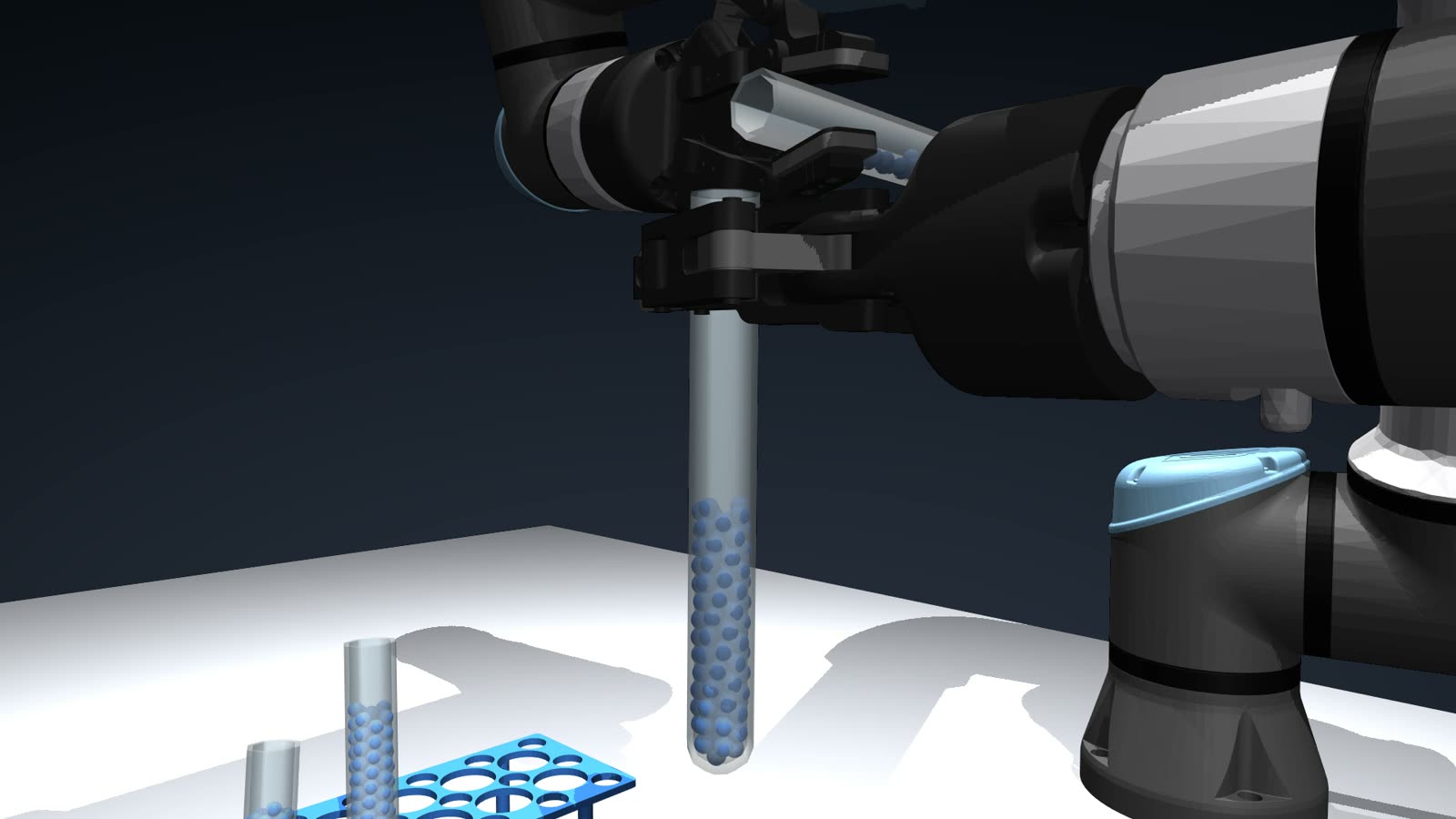
Pouring between test tubes
Two arms find the tubes, pour one into another until it is exactly half full, and put both back.
See the full run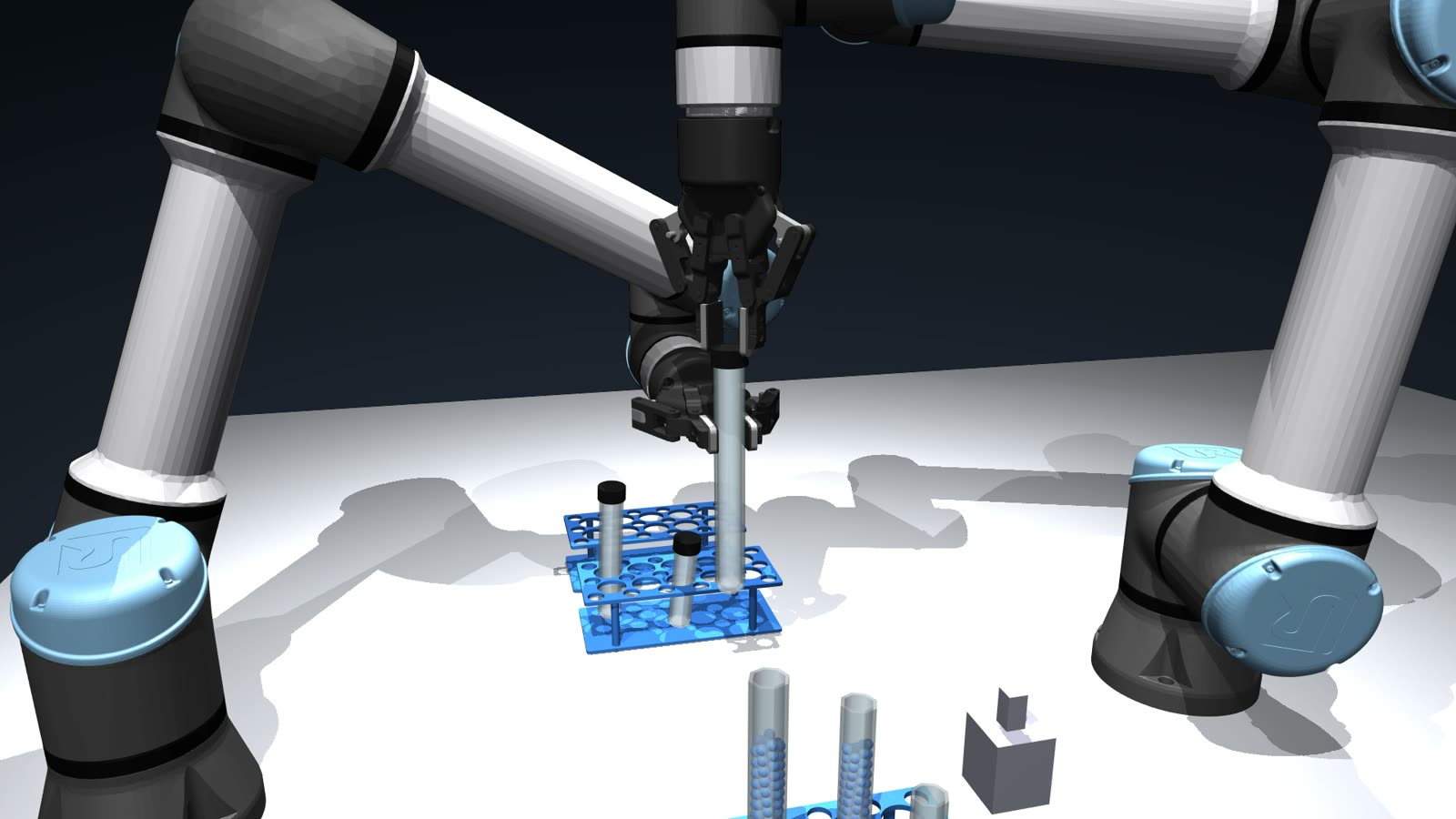
Lab automation
Uncapping screw-cap tubes
One arm holds the tube while the other unscrews the cap, feeling through its wrist when the cap comes free.
See the full run